Investigations
A core topic of the Ontology for Biomedical Investigations (OBI) is scientific investigations. There are three major phases: ‘planning’, ‘study design execution’ and ‘drawing a conclusion based on data’. An output of the planning stage is a ‘study design’ which then is executed in the second stage where data are produced which are interpreted in the third.
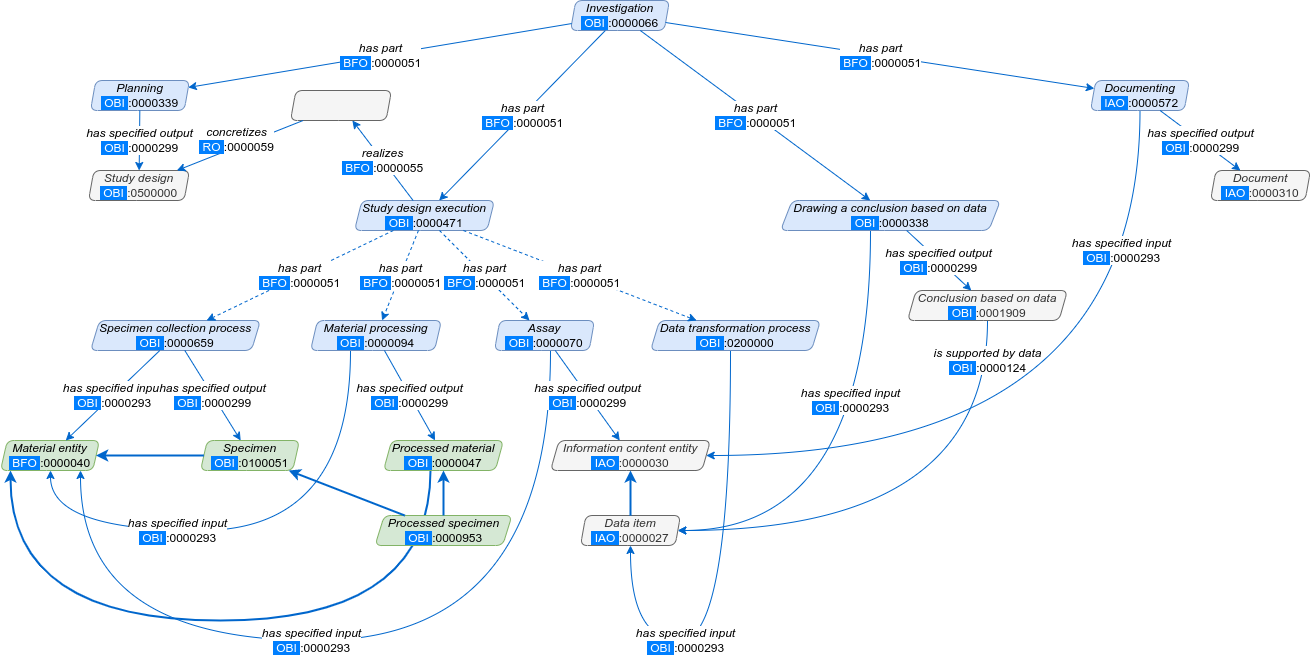
Investigation modelled according to the Ontology for Biomedical Investigations (OBI). Solid arrows represent relations prescribed by class restrictions within the OBI. Dashed lines add further relations for better understanding, following the OBI documentation. See Legend for Network Graphics for an explanation of notation.
Restrictions for OBI classes occasionally require instances for which there is no clear definition what class they belong to. First, a more specific subclass of planning needs to be defined, describing the process that leads to the establishment of a study design. Also, the study design execution does not realise the study design directly but some direction concretising the study design in respect of the investigation to be carried out. This mechanism allows study designs to be defined on a general level for use in several investigations. Each investigation interprets the study design in terms of its specific context, e. g. the material to be used or the facilities at disposition. Several classes are related to class ‘study design’ through the ‘has part’ property, providing specifications for many of the processes and input/output elements subsumed under ‘study design execution’.
‘Study design execution’ consists of a sequence of processes that have input and output objects in a way that the output of the previous is the input to the following. The ‘specimen collection process’ selects human remains from a collection of material for investigation. The selected material is then referred to as ‘specimens’. Specimens can be further processed, e. g. if samples are taken or thin sections produced. Specimens are subjected to a number of assays, e. g. structured observations, measurements or analyses. The resulting data items are understood as measurement data. Data processing can also be part of study design execution, subsuming processes like aggregation of multiple data items, calculations and statistical analyses.
Investigations close with one or several conclusions. Conclusions contain specifications of the data items on which they are based. The OBI also offers concepts for modelling the publication of resulting data items and conclusions in publications.